One day, your dog is chasing a ball in the backyard. Next, they are holding one leg up and refusing to put weight on it. Maybe you heard a yelp. Maybe you did not hear anything at all, which somehow feels worse. You bring them in, the vet runs through the exam, and then you hear: cranial cruciate ligament tear.
For most people, the next words they hear are TPLO surgery.
That is a lot to absorb in a single appointment. TPLO is not a minor procedure. It is also not something to be afraid of once you understand what it actually does, why it works as well as it does, and what the road to recovery looks like. This guide walks through all of it so that if your dog ends up needing dog ACL surgery, you are walking into that decision informed rather than overwhelmed.
What Is a Cranial Cruciate Ligament Tear in Dogs?
Before getting into the surgery itself, it helps to understand the injury.
The cranial cruciate ligament (CCL) is a band of tough connective tissue inside the knee joint that holds the femur (thigh bone) and tibia (shin bone) together. It prevents the tibia from sliding forward relative to the femur and keeps the joint stable during movement. In humans, the equivalent structure is called the ACL, which is why you will often hear vets and owners refer to this as a dog ACL injury.
CCL tears are one of the most common orthopedic injuries seen in dogs. According to a study published in the Journal of the American Veterinary Medical Association, approximately 600,000 dogs undergo surgical treatment for CCL rupture in the United States every year. Unlike the sudden trauma-based ACL tears common in human athletes, most CCL injuries in dogs happen because of gradual ligament degeneration over time. The fibers weaken progressively, and at some point, the structure gives way, sometimes during normal activity that should not have caused any injury at all.
This is important because it means the other knee is often at risk too. Research suggests that roughly 40 to 60 percent of dogs with a CCL tear in one leg will experience a CCL tear in the opposite leg within one to two years. Your vet will likely discuss both knees when talking through your dog’s treatment plan.
What Is TPLO Surgery?
TPLO stands for Tibial Plateau Leveling Osteotomy. It sounds complicated, and the mechanics behind it are genuinely clever once you understand the logic.
In a healthy knee, the cruciate ligament works by counteracting the forward thrust of the tibia that happens every time a dog bears weight. When the ligament tears, nothing stops that forward slide, and the joint becomes unstable. Cartilage and meniscus damage follow quickly if the problem is not corrected.
TPLO surgery does not replace the torn ligament. Instead, it changes the geometry of the joint so the ligament is no longer needed to maintain stability. The surgeon makes a curved cut in the top of the tibia (the tibial plateau), rotates the bone slightly, and secures it in the new position with a bone plate and screws. This changes the angle of the tibial plateau so that when the dog bears weight, the joint stays naturally stable without requiring the missing ligament.
The result is a joint that works without relying on a structure that is gone and cannot be adequately replaced.
TPLO was developed in the 1990s by Dr. Barclay Slocum and has become the most widely performed surgical treatment for CCL tears in medium- to large-breed dogs. It has an extensive body of research behind it and a success rate that most other procedures have not matched.
TPLO vs. Other Surgical Options
If your vet or a specialist has mentioned other procedures, here is a brief overview of how they compare.
Lateral Suture (Extracapsular Repair)
This technique involves placing a strong suture outside the joint to mimic the function of the torn ligament. It is generally considered more appropriate for small dogs (under 15 kg) and may not hold up as well under the forces generated by larger or more active dogs over time.
TTA (Tibial Tuberosity Advancement)
TTA is another bone-cutting procedure that, like TPLO, changes the biomechanics of the joint to eliminate the need for the cruciate ligament. Some studies suggest comparable outcomes between TPLO and TTA, though TPLO tends to be more commonly recommended in North America and has a longer clinical track record.
TPLO
For medium, large, and giant breed dogs, TPLO is the most recommended surgical option in current veterinary orthopedic practice. Studies consistently show return-to-function rates of 85 to 95 percent, with most dogs achieving normal or near-normal limb use after full recovery. A study in Veterinary Surgery found that over 90 percent of dog owners reported their pets returned to normal or improved function following TPLO.
The best procedure for your dog depends on their size, age, activity level, and the specific anatomy of their joint. Your veterinarian will help you navigate this.
What Happens Before Surgery?
Before scheduling TPLO surgery for your dog, your vet will do a thorough evaluation to confirm the diagnosis and assess your dog’s overall health.
Physical examination: Your vet will evaluate the joint stability using specific diagnostic tests, including the cranial drawer test and the tibial thrust test. Both assess whether the tibia is moving abnormally relative to the femur.
X-rays: Radiographs of the affected knee (and often both knees) allow your vet to measure the tibial plateau angle, check for arthritis, and evaluate the meniscus where possible. The plateau angle measurement is what the surgeon uses to calculate the exact degree of correction needed during TPLO.
Pre-surgical bloodwork: A full pre-anesthetic panel checks organ function and helps your veterinary team customize the safest anesthetic protocol for your dog. For older dogs or those with known health conditions, additional diagnostics may be recommended.
Weight management: If your dog is overweight, your vet may recommend losing some weight before surgery. Excess body weight puts significantly more strain on recovering joints and can affect long-term outcomes.
What Happens During TPLO Surgery?
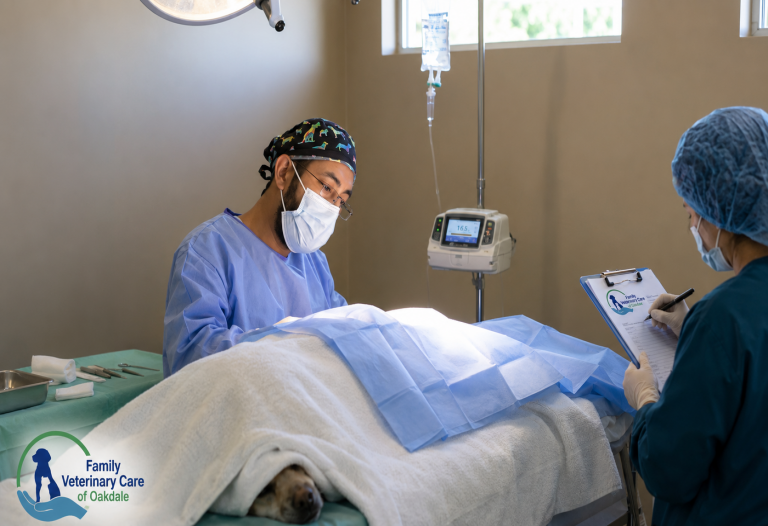
TPLO is performed under general anesthesia. A dedicated team member monitors your dog throughout the procedure, tracking vital signs, anesthetic depth, blood pressure, and oxygen levels in real time.
The surgeon makes an incision along the inside of the knee to access the joint. The joint is examined directly at this point, and the meniscus is inspected for tears. Meniscal damage is present in roughly 30 to 40 percent of dogs with CCL tears, and if a tear is found, the damaged portion is removed during the same procedure to prevent ongoing pain.
After the joint inspection, the surgeon makes a curved osteotomy (bone cut) in the tibial plateau, rotates it to the calculated angle, and secures it with a stainless steel or titanium bone plate and screws. The incision is closed in layers.
The entire procedure typically takes one to two hours, depending on the complexity of the case.
What Does Recovery Look Like?
Recovery from TPLO surgery is a process, not an event. It takes time, and how well it goes depends almost entirely on how consistently you follow the post-operative instructions your vet gives you. Dogs who recover well are almost always dogs whose owners stuck to the plan even when it was difficult.
The first two weeks
Your dog comes home with pain medications, anti-inflammatories, and an e-collar to prevent licking at the incision. Activity is strictly limited. Short, controlled leash walks (five to ten minutes, two to three times a day) are the only exercise permitted. No running, jumping, stairs, or off-leash time.
Swelling around the incision is normal in the first few days. You will have a follow-up appointment scheduled around the 10- to 14-day mark to check the incision and remove sutures.
Weeks two through eight
As the bone heals and pain decreases, your dog will gradually want to do more than you are ready to allow them to do. This is the hardest part for most owners. The bone needs time to incorporate the plate fully, and overexertion during this window can cause complications. Walk times increase slightly, but off-leash activity is still off the table.
Physical rehabilitation exercises are often introduced during this phase. Range-of-motion work, controlled weight shifting, and hydrotherapy (if available) help maintain muscle mass and encourage proper limb use. At Family Veterinary Care of Oakdale, we incorporate pain management strategies, including laser therapy, into post-operative care, which can meaningfully support recovery.
Eight to sixteen weeks
Follow-up X-rays around the eight-week mark confirm whether the bone is healing on schedule. If healing looks good, activity is progressively increased. Gentle off-leash time in controlled environments may be introduced.
Four to six months
Most dogs are back to normal or near-normal activity levels by four to six months post-surgery. Large and giant breed dogs may take longer. Full bone healing typically occurs between three and four months, but soft tissue healing and muscle rebuilding continue beyond that.
Signs of Complications to Watch For
Complications after TPLO are not common, but knowing what to look for allows you to act quickly if something changes.
Contact your vet immediately if you notice any of the following:
- The incision is opening, oozing, has significant swelling, or shows signs of infection (increased redness, warmth, or discharge)
- Your dog is bearing less weight on the leg than they were in the days before
- Your dog shows a sudden increase in pain or cries when the leg is touched.
- Your dog is running a fever, seems unusually lethargic, or stops eating.
Implant complications (plate loosening or infection) are rare but possible and are addressed surgically if they occur. Meniscal tears that were not present at the time of surgery can also develop later and cause renewed lameness. This is one of the reasons follow-up appointments matter.
How Much Does TPLO Surgery Cost for Dogs?
Cost is a real concern, and it is worth discussing directly. TPLO surgery is not inexpensive. The total cost typically ranges depending on geographic location, the experience of the surgical team, the size of the dog, and whether any additional procedures are needed (such as meniscal treatment or bilateral surgery).
At Family Veterinary Care of Oakdale, we provide a detailed estimate before any procedure so there are no surprises. We also offer payment options, including CareCredit and Scratchpay, to help make care accessible when the need is unexpected. We would rather have an honest conversation about cost than have a dog go untreated because the financial aspect felt like a wall.
It is also worth knowing that dogs with CCL tears who do not receive surgical treatment typically develop significant arthritis and long-term pain over time. Conservative management (rest, anti-inflammatories, physical therapy) may reduce symptoms temporarily in small dogs. Still, it does not restore joint stability in larger dogs and is not a substitute for surgery when surgery is indicated.
Conclusion
A CCL tear is a difficult diagnosis to hear, but TPLO surgery gives most dogs a real path back to the life they had before the injury. The procedure is well-established, the recovery is predictable when owners stay the course, and the outcomes speak for themselves across decades of clinical use. If your dog has been diagnosed with a CCL tear or you are seeing the signs of a knee problem and want it properly evaluated, the team at Family Veterinary Care of Oakdale is here. Request an appointment or call us at (209) 847-9077. We serve dogs and their families across Oakdale, Riverbank, Escalon, and the broader 209 region.
Frequently Asked Questions
How do I know if my dog has torn their CCL?
The most common signs are sudden lameness or a reluctance to bear weight on one hind leg, often after exercise or play. Some dogs will walk on their leg but with a noticeable limp. In cases of partial tears, the lameness may come and go before becoming consistent. Your vet will confirm the diagnosis through a physical examination and X-rays. Do not wait if your dog is not putting weight on a leg. The sooner the injury is evaluated, the sooner it can be treated.
Is TPLO the only option for a dog with a CCL tear?
TPLO is the most commonly recommended option for medium- to large-breed dogs and has the most supporting research behind it. Other procedures, such as TTA and lateral suture repair, exist and may be appropriate depending on your dog’s size and specific situation. Conservative (non-surgical) management is generally not recommended for dogs over 15 kg, as it does not restore joint stability and typically leads to ongoing arthritis and pain.
What is the success rate of TPLO surgery?
Studies consistently report that 85 to 95 percent of dogs return to normal or near-normal function following TPLO surgery. Outcome is strongly influenced by how well post-operative care instructions are followed, especially activity restriction during the healing period.
How long will my dog need to be on restricted activity after TPLO?
Strict activity restriction typically lasts four to eight weeks. Gradual return to normal exercise begins after follow-up X-rays confirm adequate bone healing, usually around the eight-week mark. Most dogs are back to full activity between four and six months post-surgery, though larger breeds may take a bit longer.
Will my dog need surgery on the other knee too?
Not necessarily, but the risk is real. Research suggests that 40 to 60 percent of dogs with a CCL tear in one leg will eventually develop a tear in the opposite leg. Your vet will monitor both knees and discuss this with you as part of your dog’s ongoing care.
My dog is older. Is TPLO still a good option?
Age alone is not a reason to avoid surgery if the injury warrants it. Senior dogs can and do recover well from TPLO, though pre-surgical health screening is particularly important in older patients. Your vet will have an honest conversation with you about the risks and benefits based on your dog’s specific health status.
Where can I find dog ACL surgery in Oakdale, CA?
Family Veterinary Care of Oakdale offers surgical services, including TPLO for dogs with CCL injuries. We are located at 389 W F St, Oakdale, CA 95361. You can reach us at (209) 847-9077 or book an appointment online. We serve pet owners from Oakdale, Riverbank, Escalon, and the surrounding 209 area.


Leave A Comment